Grassroots Research
Social
Grassroots Research offers expertise to organizations interested in community-based research using peer research consultants. Involving individuals who live in or have connections to a particular community is often very effective in carrying out research projects as the peer researchers typically have an in-depth understanding of issues through lived experience.
We are part of Working for Change, an organization established in 1994 to provide employment opportunities for people with mental health issues. Located in the Parkdale neighbourhood in Toronto, we have strong ties to a community where many residents struggle with poverty and mental health-related barriers. We train people to become peer researchers, giving them an opportunity to earn an income while working with an experienced research professional throughout the entire process. Our peer researchers are often graduates of our programs but we can also train members of the community in which the research project is rooted.
Community Background
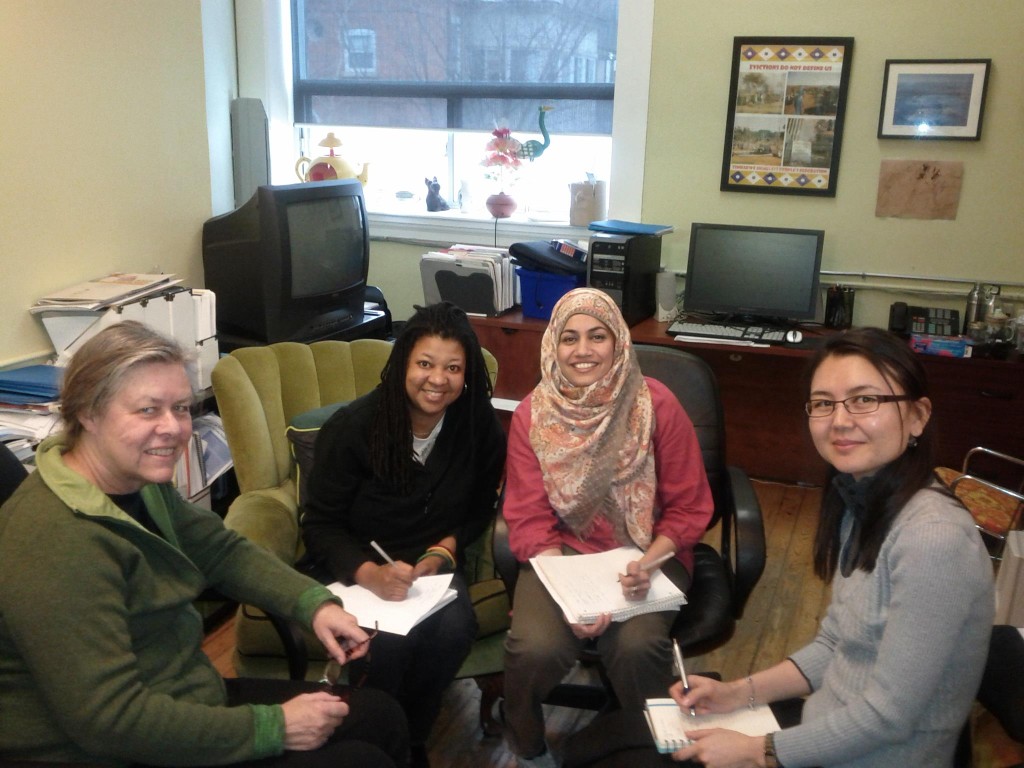 Grassroots Research is part of Working for Change, formerly the Ontario Council of Alternative Businesses (OCAB), a nonprofit organization established in 1994 to respond to the need for employment opportunities for people with mental health issues. Over the years, we have developed several social enterprises to realize our social mission.
As part of our mandate to develop new and innovative employment opportunities, we have conducted a variety of community-based research projects for other nonprofits, community agencies, and academic institutions in the Greater Toronto Area. Grassroots Research projects explore poverty-related issues, but we occasionally also conduct research for other populations such as senior citizens. Over the past few years, more and more organizations and academic institutions are recognizing the importance and usefulness of community-based research. We can provide our own community researchers or train members of the community where the project is focused. Individuals who live in or are part of a particular community are often very effective in carrying out research projects as they typically have an in-depth understanding of issues such as poverty and homelessness, and they may be able to engage research participants more effectively than a professional. Sometimes our researchers might not live in the area where a study is taking place, but they may have similar life experiences.
Development History
Grassroots Research started because of expertise available. One of our staff has extensive research experience on housing and homelessness. Having developed and operated several other social enterprises that train and employ psychiatric consumer/survivors, we discovered that people often wanted work that was more related to social services or they were interested in becoming involved in research.
Since its beginning, Grassroots Research has been designed to operate as a sideline project, not as one of our core enterprises. The early stage of social enterprise development started in 2004, when we trained six peer researchers to conduct interviews with Parkdale Activity Recreation Centre (PARC) members to gather data on their work histories, as well as their employment aspirations. Voices from the Street, one of our programs, evolved in part as a response to the desire of PARC members to be more involved in social service/advocacy work. In 2006, we completed a research project for Trinity Square Enterprises, facilitating focus groups of program participants and conducting interviews with staff to evaluate the training aspect of the enterprise.
The milestone that brought Grassroots Research to life happened in 2008, when Working for Change and members of Voices from the Street were contracted to conduct research on the efficacy of education about bed bugs in boarding homes. The researchers completed 134 interviews with boarding home tenants and 15 interviews with boarding home operators. Since then, we typically work on several research projects annually.
Revenue Model
We are not trying to grow the business, but rather maintain it as sideline to our other enterprises. As staff time resources are donated by Working for Change, Grassroots Research has no overhead costs, but also constrained in its capacity to take on a large number of projects. Since the first contract (the joint project between Woodgreen and Habitat Services), our business model has not changed. We do not actively advertise our services, relying on opportunities through word of mouth, and referrals from our existing network of community organizations. Most contracts are small in scale (bringing about $5,000-$10,000 of income to the organization), but sometimes we do conduct large studies.
Challenges
As noted above, we do have limited capacity to take on research. The challenge is to pace what we can do with available resources. Also, because we do not actively seek out contracts, sometimes there is a long period between contracts or we may get work during a busy period. The irregular nature of the business also means that even though our community researchers are paid a significant rate of $20 per hour, their income is sporadic.
Each project is unique, making our experience with each one very different. Some large contracts require collecting and handling a massive amount of data. For example, one of our recent projects involved 300 questionnaires with over hundred questions. We were lucky to have a Masters student at that time to assist us with the project.
Sometimes organizations coming to Grassroots Research ask us to train some of their own community members. This can create challenges as not everyone is suited this type of work. When we bring in our own community researchers, it is easier. Community peer researchers need to grasp interview dynamics while using listening and note taking skills. Over the years, we have learned to make it clear to organizations that we are happy to work with their community members, but a screening process is important to make sure the potential researchers possess the skills to carry out the work.
Lessons Learned
Grassroots Research has been successful as a sideline activity to bring extra income into our parent organization. The nature of our operations is very sporadic, depending on staff availability and contract opportunities that come to us; this makes us very different from the other social enterprises that Working for Change operates.
Though this enterprise is not easily replicable, using people from an organization as consultants to generate revenue through occasional contracts could work for other organizations. The model combines well with our mission to provide employment/training for marginalized populations. In the case of Grassroots Research, key success factors were the following:
- Having strong community relationships is crucial for business.
Our contracts have come to us through word-of-mouth from our network of partner organizations. Having community connections also gives us access to the pool of community researchers. - Ensuring the parent organization has adequate resources to support the social enterprise.
Without the donated resources from Working for Change, Grassroots Research would not be able to operate. It is crucial for a parent organization to have the human resources, technological and physical infrastructure, as well as the administrative capacity to support the social enterprise. - Having research expertise available in the team.
We would not suggest setting up a research services-based enterprise unless there is such expertise available in the organization. At Working for Change, our extensive experience in developing other social enterprises has also contributed to our success. For organizations already doing research or policy-related work, incorporating community researchers could enhance their work. - Being realistic about staff availability and ensuring that they have the time to dedicate to additional projects.
Because each contract requires a significant amount of time, it is extremely important to make sure the organization’s staff is prepared to take on the new projects.
Support
Because we are a unique social enterprise with few overhead requirements, we do not need much support. Grassroots Research only operates when we have contracts as we do not actively market our services. One area in which we might use some help would be in building a better website and developing a plan to target our marketing.
Organization Structure
A part of Working for Change, Grassroots Research would be best classified as one of many organizational activities or projects. Although considered a social enterprise, Grassroots Research does not exist as a separate legal entity. Dr. Joyce Brown, the Executive Director of Working for Change, acts as the lead researcher and supervises each project. The parent organization provides all the resources Grassroots Research needs to operate: paid staff time, office space, computer equipment and software, administrative support, etc.
Partnerships
Working for Change has worked with a number of organizations including AIS (a housing organization), Habitat Services, Parkdale Activity-Recreation Centre, The Toronto Enterprise Fund, Trinity Square Enterprises, WoodGreen, and the Centre for Urban and Community Studies at the University of Toronto, on issues ranging from tenant satisfaction, peer work, and employment to the prevention and treatment of bed bugs.
Our community relationships have always played an essential role in establishing the social enterprise reputation in community-based research and securing contracts through word-of-mouth. For example, we obtained our first large contract because of our connection to Woodgreen Community Centre and Habitat Services. We also get referrals through our network of existing clients, such as AIS recommending us to a seniors’ organization.
Impacts & Outcomes
Working for Change trains community members to: participate in the development of questionnaires, interview research participants, facilitate focus groups and participate in data analysis. The community researchers learn a number of transferrable skills through the training they receive. They also gain information about a variety of issues (social housing, peer support, tenant satisfaction, bed bugs) while earning an hourly wage that is usually significantly higher than the provincial minimum.
Another significant economic benefit is that the profit from research contracts is being reinvested in Working for Change, providing an additional revenue stream for our organization.
Vision for the Future
Grassroots Research is rather unique in because we do relatively little advertising but rather respond to requests from the community. Our business strategy has always been cautious, thus our plan for now is to continue operating at the same pace.
499 Queen Street West, Suite 203 Toronto, ON, M6R 1A3
(416) 504-1693
Last Year's Revenue was Average about $10,000 annually
Grassroots Research is a registered charity.